Women's Fitness Blog

Your Client Might Be Quietly Crumbling. Would You Know?
It comes up in almost every Menopause Training Matrix workshop I run.
Someone puts their hand up — usually someone without lived experience of menopause — and asks the question that's been sitting at the back of the room the whole time: "How do I bring up menopause without assuming? What if I get it wrong?"
It's a good question. An honest one. And it points to something real: the discomfort trainers feel about opening a conversation they weren't trained to have.
But here's what that question doesn't see. On the other side of that hesitation is a woman who hasn't said anything either. Not because she doesn't want help. Not because nothing's going on. But because nobody has asked. Nobody has drawn the dots. And so, she keeps showing up, quietly carrying the weight of symptoms she might not even have words for yet, while her trainer — the person who sees her twice a week, who notices when something's off — doesn't know how to begin.
That gap has a cost. I've been watching it play out on the gym floor for years.
The most consistent person in her health ecosystem might be you
Think about who midlife women see regularly. A GP, maybe, for ten minutes every few months if something is wrong enough to book an appointment. A specialist, if she's lucky enough to get a referral and wait out the queue. And then there's you — her trainer, maybe twice a week, sometimes more, often for months or years.
You watch her energy fluctuate across a cycle she might not even be tracking anymore. You notice when her motivation craters for two weeks and then comes back. You see her face after a bad night's sleep more often than her doctor ever will. You are, whether the industry has acknowledged it or not, one of the most consistent points of contact in her health life.
And yet the fitness industry has given trainers almost nothing systematic to do with that.
No framework for capturing what they observe. No professional language for naming what they're seeing without overstepping. No tool that makes it easier for the client to tell them what's going on — without the trainer having to assume, project, or guess.
The two kinds of clients in your studio
Here's the split I see, and you'll recognise it immediately.
There are the clients who bowl on up and don't spare a single detail. They'll tell you about their night sweats before you've finished your warm-up questions. They've been to the doctor, they've done the research, they've got opinions on MHT, and they want to know what you think. These clients are relatively easy to work with — not because menopause is simple, but because the conversation is already open.
And then there are the others. The ones who are quietly crumbling from the weight of what they're carrying, and nobody has drawn the dots for them. They're tired, but they put it down to work. They're not recovering the way they used to, but they assume it's age. They feel like themselves some weeks and completely unlike themselves others, and they haven't connected any of it to what's happening hormonally — because nobody has helped them make that connection.
These are the clients who need you most. And they're also the ones most likely to slip through the gap.
What Dr Dee built — and why it changes the equation
I recently had Dr Daniella Remy — Dr Dee — on the Women's Fitness Podcast, and I want to tell you about what she's building, because it's directly relevant to this problem.
Dr Dee is a naturopathic doctor and VP of Research at Precision Health Alliance, the organisation behind Shae — the precision health platform I've talked about in this space before. She's also, as it turns out, a woman who went through perimenopause and found that the tools available to her were inadequate.
So, she built something.
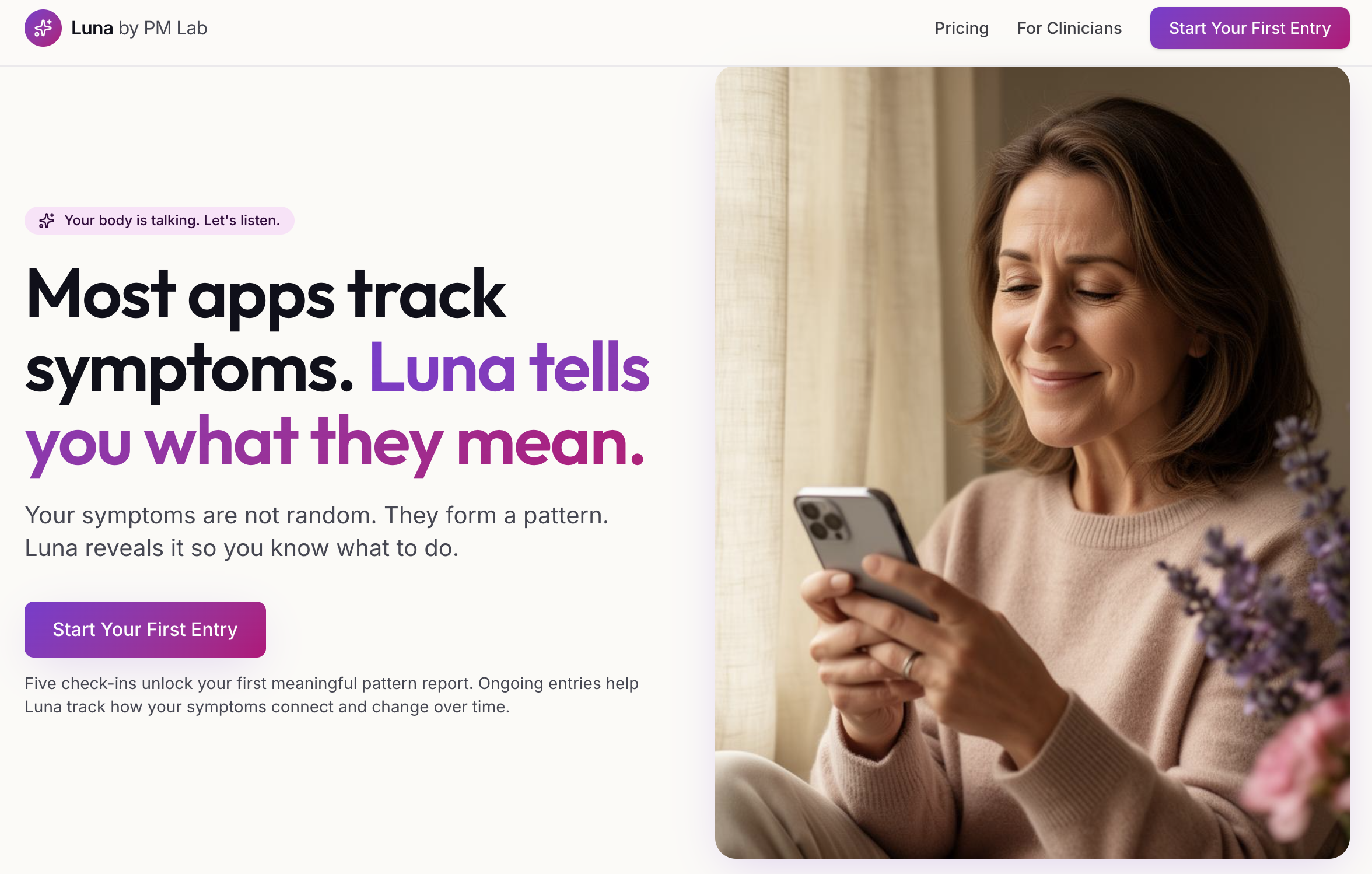
It's called Luna. And before I describe it, I want to be clear about what it isn't: it's not a symptom checklist. It's not a period tracker. It's not another wellness app with a pink interface and a vague dashboard.
Luna is a voice-based data collection tool. A woman talks — in her own words, in her own time, while she's doing the laundry or driving the car — and the app listens, tracks, and over time, starts to identify patterns. Five sessions in, those patterns begin to emerge. And then it produces something genuinely useful: a two-page, point-form clinician report that translates her lived experience into language that lands in a medical appointment.
Dr Dee puts it plainly: for women who've spent years being told their labs are normal while their lived experience says otherwise, that report means my story matters now.
The question at the heart of the whole platform — the name of Dr Dee's Facebook community, the diagnostic lens running under everything Luna does — is this: Is it hormones, or is it something else?
That question matters more than it sounds. Because defaulting to hormones as the answer to every midlife symptom is as incomplete as ignoring them entirely. Dr Dee shared her own example: feeling off, grumpy, not herself. Luna flagged iron, not hormones. Two days of supplements. Back to normal. Her words: "I should know. I just forgot."
That's the precision this space has been missing.
This is what symptom literacy looks like in practice
I want to be clear about something, because it matters for how you position yourself with clients.
Fitness professionals don't need to diagnose. They never did, and Luna doesn't change that. What they need is a way to notice, name, and refer — with tools that make that process easier, more informed, and more useful to the practitioners and clinicians the client eventually sees.
Luna is one of those tools. You can introduce it to a client who seems like she might be navigating something. You don't have to name it. You don't have to assume. You can simply say: "There's a tool I've come across that a lot of women in midlife find really useful — it helps them track what they're experiencing and put it into words. Want me to send you the link?"
The data does the asking. The app creates the conditions for a conversation the client might not have known how to start. And the clinician report that comes out the other side means the information doesn't get lost between her and the next appointment.
Used alongside education like the Menopause Training Matrix — which gives you the framework to understand what you're observing and adapt your programming in response to it — this is what genuinely individualised support for midlife women looks like. Not generic. Not assumed. Informed by what's going on for that specific woman.
The trainer in the workshop was asking the right question
Back to that hand going up. Back to: "How do I bring up menopause without assuming?"
The answer, it turns out, isn't to wait until you're certain. It isn't to stay silent because you're worried about getting it wrong. And it isn't to become a clinician.
It's to create the conditions where the client can tell you — in whatever way works for her. Sometimes that's a direct conversation, opened carefully, with the right language and a genuine ear. Sometimes it's handing her a tool that does the asking on your behalf and following up when she's ready.
Either way, the data is there. The symptoms are there. The story is there.
Someone just has to be paying attention.
Want to know more?
Luna is free to use at perimenopauselab.com. There's also a founding member rate of $75/year for premium access — unlimited clinical reports and priority access to new features, locked in permanently.
Listen to the full conversation with Dr Dee on the Women's Fitness Podcast — Your Symptoms Have a Story: Meet Luna, the AI Companion Built for Women in Midlife.
And Spotify
If you're a fitness professional working with midlife women and want to build the framework that makes sense of what you're observing, the Menopause Training Matrix is where to start. And if you want to explore WFE's full suite of women's health education — built into our Certificate III and IV in Fitness — start here.