
Women's Fitness Blog
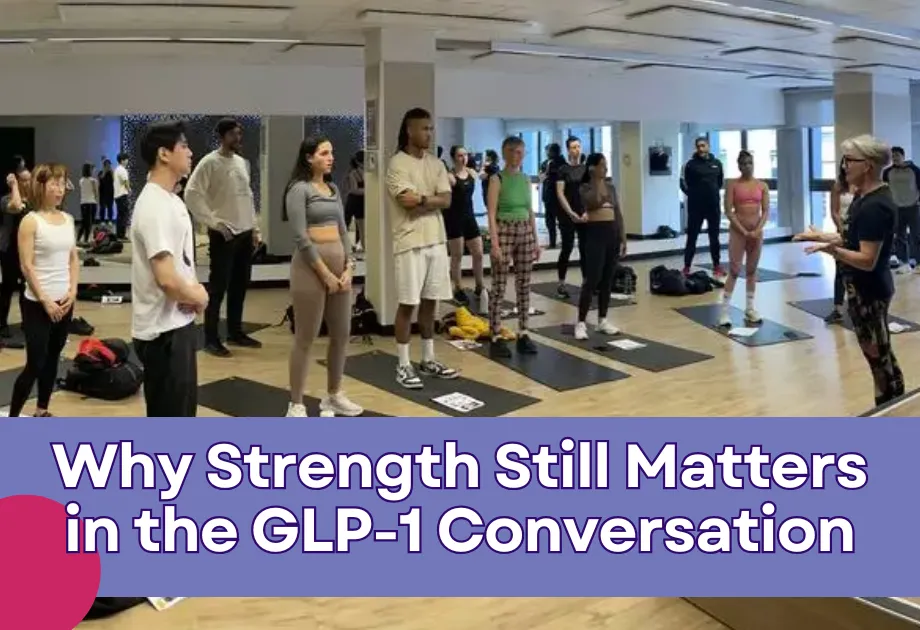
Why Strength Still Matters in the GLP-1 Conversation
The conversation around GLP-1 medications has accelerated quickly. What began as a clinical discussion about diabetes and metabolic disease has moved into mainstream weight-loss narratives, media headlines, and everyday client conversations.
For the fitness industry, this isn’t something happening around us — it’s something we are already part of.
Here’s the blunt truth at the intersection of fitness, women’s health and clinical practice:
Medication can influence appetite and weight.
It cannot replace strength.
GLP-1s change physiology — not physical capacity
GLP-1 medications work by altering appetite signalling, gastric emptying, and metabolic responses. For many people, they can be useful. That isn’t in dispute.
What is often under-discussed is what happens to the body as weight drops when there is no concurrent mechanical loading.
Rapid or significant weight loss — regardless of the method — increases the risk of losing lean mass and bone density. This is well-established physiology. The body adapts to what it is asked to do, and what it is no longer required to support.
Without resistance, the signal to maintain muscle weakens. Without impact or load, bone follows.
For women — particularly through perimenopause and menopause — this matters. Muscle and bone loss are already biologically accelerated during this life stage. Removing mechanical stimulus compounds that risk.
This is not a cosmetic issue. It is a functional one.
Strength is not a modality — it’s an outcome
One of the challenges in public discourse is that “strength training” is often treated as a specific aesthetic or gym culture, rather than a physiological requirement.
Strength is not a piece of equipment.
It is an adaptation.
It is built through exposure to load, resistance, control and recovery — whether that comes from free weights, machines, bodyweight, bands, floor work, or task-based movement.
For fitness professionals, especially those early in their careers, this distinction matters. Our role is not to defend a method, but to create the conditions for adaptation.
If the body is asked to resist force and recover appropriately, it will maintain muscle and bone. If it isn’t, it won’t — regardless of weight loss method.
Consistency is the real intervention
In discussions about strength, intensity is often over-emphasised. Consistency is far more predictive of outcomes.
Strength training only works if it is sustained. That requires programs that fit real lives — fluctuating energy, hormonal changes, work demands, caregiving roles and injury history.
Enjoyment is not a soft concept here. It is a practical one.
When movement feels meaningful and achievable, adherence improves. When adherence improves, cumulative load improves. And cumulative load is what preserves strength across decades.
This is where the fitness industry contributes something medication cannot: behavioural translation.
Recovery is where adaptation happens
Another point often lost in simplified messaging is recovery.
Muscle is not built during effort. It is built in the period that follows — when the nervous system settles, tissues repair, and the body integrates the stimulus.
When training volume, intensity and recovery are poorly matched, adaptation stalls. For clients using GLP-1s, this matters even more. Reduced caloric intake can affect recovery capacity, tissue repair and energy availability.
Programming that ignores rest is not “hardcore”. It is physiologically naïve.
Understanding recovery is not an advanced concept — it is foundational to ethical coaching.
Pelvic floor: a non-negotiable consideration
Pelvic floor health remains one of the most under-addressed aspects of women’s training, despite its enormous impact on function, confidence and long-term independence.
Pelvic floor dysfunction is a significant contributor to reduced activity participation and a known factor in transitions to assisted care environments later in life.
From a training perspective, this is not about fear or fragility. It is about precision.
Ignoring pelvic floor symptoms — or training through them without consideration — limits strength expression and discourages long-term engagement with movement. Addressing them appropriately expands capacity.
For fitness professionals, this means recognising signs, adjusting load strategies, and referring when needed — not diagnosing, but not dismissing.
The role of AUSactive and government collaboration
The fitness industry is no longer operating in isolation.
Organisations like AUSactive are actively working with government bodies, health departments and allied health sectors to position exercise — particularly strength training — as a foundational component of long-term health strategies, including those involving pharmacological interventions.
This matters for professionals entering the industry now.
The expectation is shifting. Fitness is increasingly seen as part of a broader health ecosystem — not an optional add-on, but a necessary partner in translating clinical interventions into functional outcomes.
That responsibility requires education, scope clarity and evidence-informed practice.
The bigger picture
GLP-1 medications are one tool in a complex system. They can influence weight, appetite and metabolic markers.
They do not build strength.
They do not preserve bone.
They do not teach the body how to tolerate load.
That work sits squarely within the domain of movement professionals.
Strength, recovery, pelvic floor health and long-term consistency are not competing narratives to medication — they are the missing infrastructure that makes any intervention sustainable.
For the fitness industry — and for those stepping into it now — this is the opportunity: to lead with clarity, not hype, and to anchor health outcomes in bodies that are capable, resilient and strong for life.
This media coverage from the Canberra Times raises critical points about GLP-1s and exercise; I’ve expanded on what this means for strength, women’s health and the fitness industry here.
Look out for my February blog, where I will be talking all things living with GRACE. Can’t wait to share.