
Women's Fitness Blog
Menopause and Your Clients: What Trainers Can Say
What should I say when a client asks me about menopause?
Written by Mish Wright
In my late 40s I used to jump out of bed, run down the stairs to yell at the kids to get to school. Then one morning in perimenopause I jumped out of bed and the joints in my feet were so stiff I had to take those stairs slowly and painfully. I felt like a tin woman.
It felt like it happened overnight.
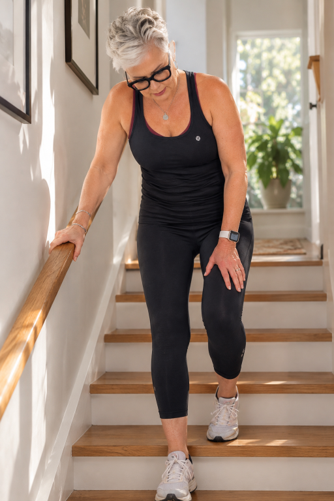
That is what "everything aches" sounds like when it walks into your studio or gym. Her feet are stiff, her sleep is rubbish and she half expects you to minimise her experience with the phrase “it is just age”.
This October, for Menopause Awareness Month, I ran two webinars for our students at WFE. I asked our students and graduate trainers about the questions they get asked most about. They came back with questions around:
· sleep
· body shape
· sore joints
· leaking
· brain fog
· and hormone therapy.
So, what do you say? Firstly, remember you don't have to fix anything. To stay safely in your scope of practice – use this approach: Listen carefully to her concerns, adapt to her symptoms, and know where and when to refer her.
That is the skill. Or as I call it in my Menopause Training Matrix™ teaching strategy – ALPS. Ask. Listen. Priortise. Support. Your Cert III and IV gave you very little on this. The gap of both menopause information and how to coach it, sits in the qualification, however, I promise you can close it quickly.
Key Takeaways:
· Your job is to notice, ask, adapt and refer.
· Symptoms identify perimenopause, not a blood test, so help your client track hers.
· When she is flat, stiff or leaking, dial the session down and keep her training.
· Pelvic floor symptoms, shoulder pain and low mood go to the right professional early.
· Hormone therapy is not yours to advise on, however you can help her prepare to talk to a menopause-informed doctor.
How do I ask without trying to fix it?
Pause when she finishes talking. She will fill the gap, and the gap is where the useful information lives. Then ask one question at a time. Reflect back what you heard ("what I'm hearing is..."). Then agree one next step together: adjust the session, watch it, or refer it. If you know the ALPS Method™ (Ask, Listen, Prioritise, Support), you will recognise the rhythm.
What sits inside your scope:
· "That's well worth raising with your GP. Is yours menopause-informed?"
· "I don't know, and I'll find out. Let's adjust today's session in the meantime."
What stays with the clinicians: diagnosing perimenopause, recommending a supplement, telling her whether she should take hormone therapy, and putting a name on a sore shoulder.
Symptoms are how perimenopause is identified, not a blood test. A doctor may order bloods to check her iron or rule out other causes, however they cannot confirm perimenopause by themselves. A list of what she has noticed gives that appointment far more to work with.
Why is she exhausted and not recovering like she used to?
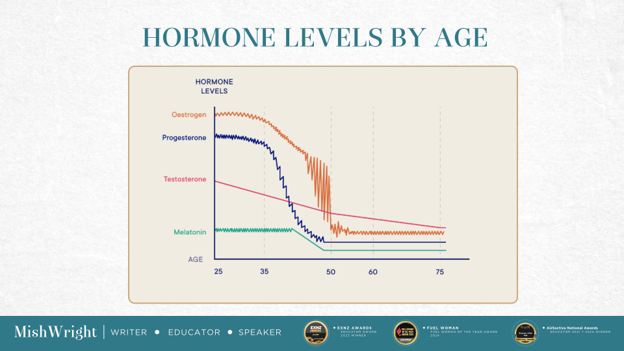
Progesterone is often the first hormone to fall, and it supports sleep, so sleep can go first. Add night sweats, and she turns up without the sleep her recovery depends on.
Oestrogen also helps limit inflammation and support muscle repair after hard exercise. (Enns and Tiidus, Sports Medicine, 2010). Your clients will often tell you: they now take longer to bounce back.
Towards the end of the menopause transition, periods can turn erratic and very heavy. Heavy bleeding drains iron, and low iron flattens energy, so this is worth asking about.
She might say: "Why am I so tired? Why don't I bounce back?"
You can say or do:
· Ask how she slept, whether she has night sweats, and whether her periods have changed or got heavier.
· Suggest she ask her GP for an iron check. It is a simple test and it can make a big difference.
· Drop the intensity when she is flat. She should walk out able to high-five you, not dragging her knuckles.
Why is her body changing when she hasn't changed anything?
Muscle becomes harder to build and hold. Fat distribution shifts towards the middle. The scales may not move at all while her body composition does. She can still build muscle and bone, however it takes a little more effort and dedication.
In my twenties in London I owned a pair of fabulous red leather trousers. Monday to Friday I ate a bit less and did a bit more cardio, and by Friday night they fitted like a dream. Plenty of your clients ran that same plan for years, until it stopped working. The old recipe of eating less and moving more simply does not work anymore.
She might say: "Why is my body changing when I haven't changed anything?"
You can say or do:
· Move the conversation off the scales. Test sit to stand, strength and mobility, and track sleep, energy and recovery between sessions. Women’s bodies are designed to morph and change with age. Teach and practice self-acceptance.
· Teach down-regulation. Make the exhale a little longer than the inhale, and habit stack it onto something she already does. Teaching breathwork only when she feels stressed is like handing her a bucket of water when the fire is raging. Do it daily and the ground is wet before the fire starts.
· Refer them to a menopause informed dietitian.
Why does everything ache?
Oestrogen influences collagen, tendon, cartilage and muscle. As it falls, joints can feel stiffer and slower to adapt, and poor sleep and stress turn the volume up. Shoulders, hips, knees, hands and heels are the usual spots.
For decades we called frozen shoulder "50s shoulder". Why? What else could be happening in a woman's life when she turns 50? The hormone link is only now getting attention, and frozen shoulder can take a long time to settle. It also makes everyday jobs hard, like doing up a bra strap or pulling a sports bra over her head.
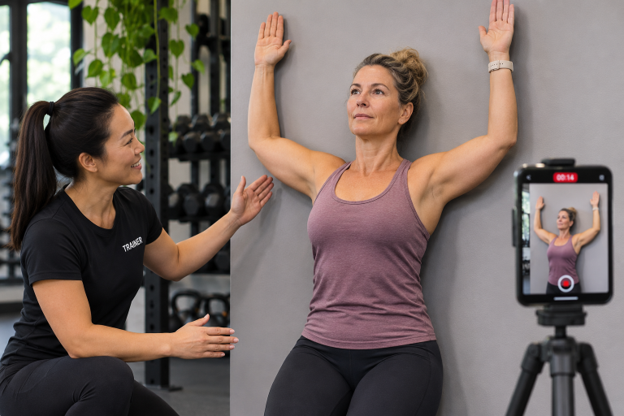
She might say: "Everything aches. Is it just my age?"
You can say or do:
· Ask what is stiff, where, and whether it is a twinge or a pain. You are gathering information, not diagnosing.
· Mobilise before you load: joint circles, wall slides, thread the needle, cat-cow, and opening and closing the hands and toes while you chat. For overhead work, start with no weight.
· Train inside the pain-free zone and keep training everything else.
· Send a sore shoulder to a physio early, even a twinge.
One safety note: pain with nausea, weakness, arm pain or chest tightness can be a heart attack, and in women it can present differently. Treat this as an emergency.
Then there is bone, which you can't see from the outside. On average, women lose up to 10% of their bone density in the first five years after menopause. Women who have trained and eaten well all their lives can still be surprised by a low result. Strength and impact work both matter. Dr Ruth White covers bone density scanning, including DEXA, in her WFE blog here, and her podcast episode is gold – listen here on Spotify and here on Apple podcasts.
What if she mentions leaking or heaviness?
Oestrogen affects collagen, and the connective tissue that holds the pelvic organs in place. A common story: a woman has a baby, has some pelvic floor trouble, and it improves over time, especially with a pelvic health physio. Then perimenopause arrives, collagen drops, and her pelvic floor has less in reserve. Leaking, urgency or prolapse can appear for the first time or existing conditions get worse. In the early stages of prolapse she often can't feel it at all and pushes through those hard training sessions.
The trigger is often something ordinary. The origin stories I heard as a trainer were: I picked up a full wheelbarrow at a school working bee. I pushed our garage door down by hand because the clicker stopped working. Shame and embarrassment are wrapped around all of it, so she may never raise it unless you ask.
She might say: nothing. That is why you ask.
You can say or do:
· Make it a routine question: "Any leaking or heaviness when you train?" For a returning client: "How did your pelvic floor feel after last session?"
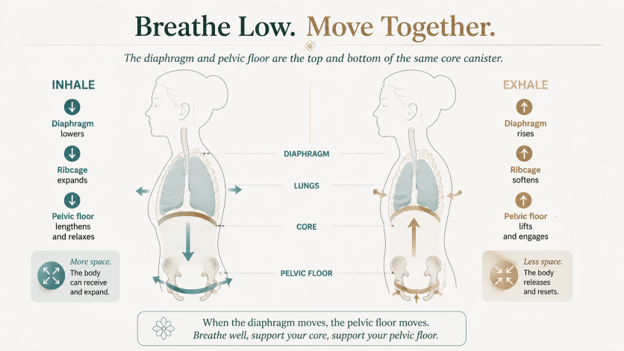
· Exhale on exertion, and blow before you go. Press through the big toe and feel the pelvic floor respond. At the top of a lift she lets it relax.
· Problem solve her day. If symptoms are worse after training, get her feet up afterwards. One client prepped her dinner vegetables sitting down on training days.
· Refer to a pelvic health physio, then ring the physio and ask what you could do more of or avoid. That physio then has a next client who wants to exercise, and they are more likely to refer their client to you.
Pelvic floor dysfunction does not kill women. Inactivity does. However, it can stop a woman coming to exercise at all, so support her through it.
My pelvic floor and menopause courses are already in your WFE portal.
Why is her brain foggy and her mood all over the place?
Brain fog is common, and it can make a woman doubt herself. Early dementia is very rare, however some women cut their hours or leave work because they think they can't cope. Anxiety and low mood can turn up for the first time in perimenopause, and poor sleep makes it all harder.
Dr Lisa Mosconi's research (Scientific Reports, 2021, and her book The Menopause Brain) found that brain changes in the transition are often temporary, and for many women they ease in post menopause when her hormones settle. Her graph also shows wide variation between women, which is why the lifestyle changes we make in perimenopause give the best bang for buck. For me personally, my brain fog eased: once my hormones settled, now I feel the sharpest I have ever been.
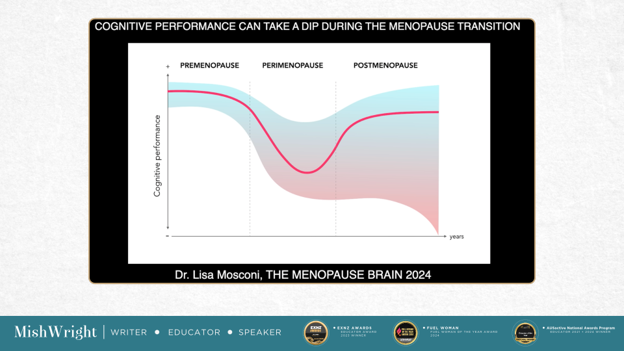
She might say: "I walk into a room and forget why. Have I got early dementia?"
You can say or do:
· Treat exercise as mental health support. Keep her training, consistent and scaled so it is achievable on a hard day.
· Add breathing and mindfulness. And keep the cardio in while everyone else is lifting heavy.
· For low mood or anxiety, suggest she see her GP, ideally a menopause-informed one. You are not diagnosing.
What if she asks me about hormone therapy?
Everyone asks. It sits outside your scope, so here is the line I use: "I can't say if it's right for you, but I can help you prepare."
Preparing means helping her track sleep, energy, hot flushes and periods. The Peri-Curious Symptom Checklist is a good place to start
Download the Peri-Curious Symptom Checklist here.
Share the changes you notice in recovery and mood, keep her training whatever she decides, and encourage her to take her notes to a menopause-informed doctor.
When she asks how to train on hormone therapy, train the woman in front of you. For the pill, or precautions after a medical menopause, the answer is a menopause-informed doctor.
Could you be the first to notice it's early?
Menopause can arrive four ways: the typical slow decline in hormones, at around 51 to 52 in Australia for white women and around ages 47 – 48 for Indigenous women (NSW Agency for Clinical Innovation); early menopause (premature ovarian insufficiency, before 40); surgical menopause, when the ovaries are removed; and medical menopause, triggered by chemotherapy, radiation or medication.
The signs are the same: hot flushes, poor sleep, mood changes, brain fog, and changed or missed periods, often stronger and sudden after surgery or cancer treatment. They are easy to blame on stress, work or kids, and her GP may not see it. You see her every week.
If her periods have been missing for three months or more and she is under 45, suggest she talk to her GP. Earlier menopause can affect bone and heart health, so strength and impact work matter even more.
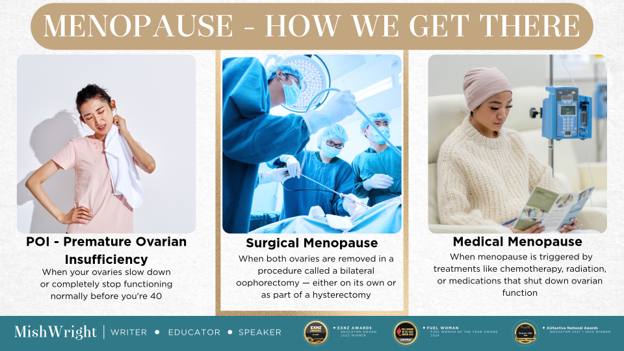
Each route can come with grief, even for a woman who never planned children. Listen, acknowledge it, and encourage her to find support from a counsellor or psychologist.
How does GRACE Midlife Movement™ help me apply all this?
Cert III and IV teach FITT (frequency, intensity, time and type), a good place to start a program. Midlife women need a weekly lens too. When Jono from Fitness Education Online asked me to write programs for trainers for midlife women, I said no, because a generic program fails the individual. But I wanted a framework that could help trainers, so I came up with GRACE Midlife Movement™.
GRACE Midlife Movement™ has five elements plus a Wild Card: Grit, Regulate, Accumulate, Cardio, Endurance, and a Wild Card for when life goes sideways.
Check out the GRACE Midlife Movement website – where there is a page dedicated to FREE resources.
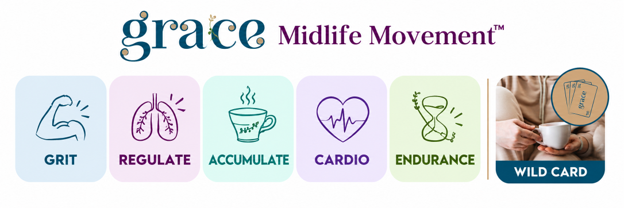
Dial up:
· Grit: progressive overload. It doesn't have to be weights. Get creative.
· Impact for bone: hops, skips and jumps, with her pelvic floor in mind. Teach her to jump off a low step first, landing soft with an exhale. Ten jumps off a step on every walk adds up.
· Accumulate: ask what she loved doing as a girl, and bring a bit of it back. Bike riding. Tap dancing. Joy is what makes it stick.
· Regulate: slow the breath and add mobility.
Dial down, not off:
· Exhausted and sleeping badly: shorter sessions, more regulate and mobility.
· Leaking or heaviness: no breath holding or straining, a lighter load, and a referral.
· Sore shoulder: no forced range or heavy overhead pressing.
· Hot flushes: a mini fridge and a few damp, rolled-up flannels. At a women's gym where I worked years ago, every member got one. It costs almost nothing.
Frequently asked questions
What is the difference between perimenopause and menopause?
Perimenopause is the transition, when cycles change and symptoms can start, often years before periods stop. Menopause is the point after one full year without a period, and postmenopause is everything after that. On average, menopause arrives at around 51 to 52 in Australia and around 47 for Indigenous women, though the timing varies widely. Perimenopause can start up to 10 years before that end point.
Can a blood test tell her she is in perimenopause?
No. Symptoms identify perimenopause, so a tracked symptom list is the most useful thing she can take to her doctor. A doctor may still order bloods, often to check iron or rule out other causes, but the results cannot confirm perimenopause on their own.
What if I am not sure something is within my scope?
Ask, listen, then refer. You can notice patterns, track what she tells you and adjust training. You cannot diagnose perimenopause, recommend supplements or advise on hormone therapy. Say, "That's worth raising with your GP. Is yours menopause-informed?" It is also fine to say you don't know and will find out.
How can she find a menopause-informed doctor?
The Australasian Menopause Society keeps a list of menopause-informed doctors, and has a symptom checklist she can take to an appointment. If a GP waves her away with "you're too young", she can ask for a second opinion. A doctor you trust personally, is also one you can refer to.
Check out AMS Here – they also have plenty of free resources to look at.
Can she still build muscle and bone in menopause?
Yes. Muscle and bone both get harder to build and hold, however it is not impossible! Strength training and impact work still help. Women can lose up to 10% of bone density in the first five years after menopause, so progressive strength and graduated impact matter. Choose movement she enjoys, because that is what she will keep doing.
Where do I start this week?
Pick one client. Ask how she has been sleeping, then pause and let her fill the gap.
The Menopause Training Matrix covers five symptom areas: vasomotor and sleep, body shape and metabolism, cognitive issues and mental health, pelvic floor, and the musculoskeletal syndrome of menopause. If you are in Perth and want to go deeper in person, I am running my Menopause Training Matrix workshop on Monday 16 November, my last for the year.
Want to know more? Check out this link for all details.
And the next time she walks in from the stairs, ask her how her feet feel this morning.
Sources
Enns DL, Tiidus PM. The influence of estrogen on skeletal muscle. Sports Medicine, 2010;40(1):41-58.
NSW Agency for Clinical Innovation, Menopause Initiative: What is menopause? and Aboriginal and Torres Strait Islander experience of menopause (citing Jones et al., BMC Women's Health, 2012).
Better Health Channel (Victoria): Menopause and osteoporosis.
Mosconi L et al. Menopause impacts human brain structure, connectivity, energy metabolism, and amyloid-beta deposition. Scientific Reports, 2021. Mosconi L. The Menopause Brain.